




What If Your Landscape Could Change How Your Home Feels?
It is a January morning and the cold sits heavy in the open. A few steps on, you find a sunlit lawn with planting behind it that breaks the wind, and you linger
Now flip the calendar. .It is a May afternoon in NCR. You cross an exposed concrete path and the heat comes up through your shoes. Twenty steps later you are under a tree canopy, and something eases.
Same city, completely different feel. That difference is a microclimate, and it is one of the most underrated ideas in residential design.
What Exactly Is a Microclimate?
A microclimate is the set of conditions in a small, localised area that can differ from its surroundings. A courtyard can feel unlike the road outside it. A tree-lined lane can feel unlike a parking bay a hundred metres away.
Several things shape it:
- Shade and sun exposure
- Surface temperatures
- Wind and air movement
- Humidity
- Planting and tree cover
- Water features
You don’t need a meteorology degree to feel these. You notice them every time you pick one side of the street over the other.
Why Microclimates Matter, and Why Not Only in Summer
Delhi-NCR has demanding weather all year: long, intense summers, a humid monsoon, and cold, foggy winters. The region has also been building fast. Hard, dry surfaces such as roads, roofs and pavements absorb heat and offer little shade or moisture. That feeds the urban heat island effect, where built-up areas run warmer than their surroundings.
A study of Delhi-NCR covering 2005 to 2020 found that plantation cover fell from about 37% to about 17% while built-up area rose from about 17% to 42%, and the urban-rural temperature gap widened from 2.7°C to 3.9°C. Those are regional figures, not a promise about any single site. They do show why comfortable outdoor space has become a real design question and not a finishing touch.
Outdoor comfort is also not a summer-only problem. A space that is lovely in March but unusable in June, or pleasant in June but cold and bleak in December, gets used for a few weeks a year. A well-designed microclimate keeps outdoor space worth stepping into across the whole calendar.
For someone choosing a home in Greater Noida West, the practical question is simple: will I actually want to be outside, in any month?
How Landscaping Shapes the Microclimate
Trees and shade. A tree canopy blocks solar radiation before it reaches the ground, the wall or you. The US Environmental Protection Agency notes that shaded surfaces may be 11–25°C cooler than the peak temperatures of unshaded materials. That is a surface figure from US conditions, not an air temperature, but the principle holds in NCR.
Evapotranspiration. Plants draw water up through their roots and release it as vapour through their leaves, using heat from the air in the process. The EPA estimates that evapotranspiration, alone or combined with shading, can help reduce peak summer temperatures by 1–5°C. Plants are not air conditioners, and results depend on the plants, the site and the weather.
Hardscape and softscape. Hardscape is concrete, paving and roads. Softscape is trees, shrubs, grass and planting beds. Continuous paving reads as glare and radiated heat. Planted areas break that up and change what the surrounding surfaces are doing.
Wind, sun and layout. In the cooler months the same logic works in reverse. Planting and landscape mounds can soften wind, and open lawns placed to catch the sun become the places people gravitate toward. How open spaces, pathways, buildings and planting relate to each other decides how a site feels in every season.
Maesta’s Approach: A Landscape Designed Around the Seasons
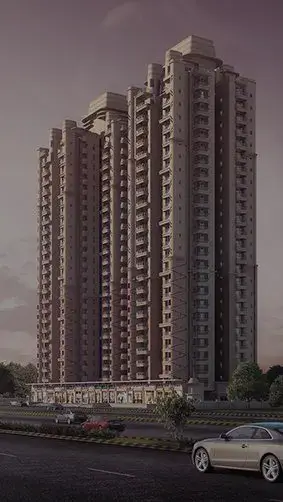
Maesta, by CRC Group in Sector 1, Greater Noida West, is presented as a landscape-led community. Its landscape concept sets out a clear goal: an environment with no thermal stress across seasons, with planting that acts as “nature’s air conditioner” by providing shade, supporting evapotranspiration, improving air quality and helping control noise.
What follows is our reading of that concept through the ideas above, not a set of measured claims.
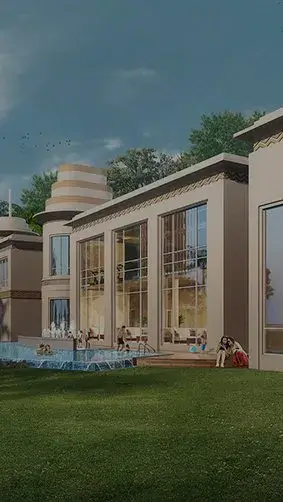
Summer. The concept includes a dedicated Summer Lawn, tree planting for shade, water features at arrival and around the clubhouse, and dry mist fans proposed to enhance the cooling effect.
Winter. There is a Winter Lawn and a Winter Garden, planned for the colder months rather than leaving winter as an afterthought. The clubhouse level also features an all-season pool, so the amenity doesn’t switch off when the temperature drops.
Through the year. Seasonal colour planting is paired with perennial planting so the landscape keeps changing, with colour and texture in different months. Native and naturalised planting is chosen for resilience and easier upkeep.
On wet or hazy days. Stilt landscapes under the towers and raised pavilions create covered and semi-covered places to walk, sit and play.
A Landscape That Has Something for Everyone
A comfortable microclimate only matters if people have reasons to step into it. That is where the concept goes beyond cooling and shade. It is built around the idea of creating a place for all activities, all seasons and everyone in the household.
The landscape is a sequence of different outdoor experiences rather than one big lawn. There are play areas, a shallow pool for little swimmers, a butterfly garden and a colour garden where curiosity takes over. There are seating alcoves for those who want to sit with friends, a swimming pool, an amphitheatre and party lawns for gatherings. The jogging trail, outdoor gym, multi-purpose court and yoga and meditation lawn serve the daily fitness routine, while a quieter park with flower and herb gardens, an aromatic garden, a reflexology path, a forest walk and a garden of tranquility offer slower, calmer ways to spend the day. Meandering paths, water features and varied planting connect these spaces, and the layout favours pedestrians so that walking between them is part of the experience.
This is where the microclimate and the inclusivity come together. A landscape can be planned for everyone on paper, but if the shade fails in June or the wind bites in January, everyone is back indoors. Shade, sun, planting and water are what make these spaces usable by the whole household in every season, and that is what makes the variety real.
From Landscaping to Everyday Living
The morning walk. In summer, a shaded path makes an early start inviting. In winter, a sunny stretch makes it bearable.
The afternoon pause. A shaded bench by the herb garden, or a lawn in winter sun, gives you a reason to step out of the house.
The after-school hour. Time at the play areas and the butterfly garden, instead of one more hour on a screen.
The evening outdoors. When outdoor spaces stay comfortable as the day cools, households linger and neighbours actually meet.
The arrival. Greenery and water at the entrance shape the first impression of a home, and coming back to planted surroundings feels different from coming back to paving.
The Bigger Idea: Climate-Conscious Living
Maesta is one example of a wider shift. Modern residential design is paying more attention to thermal comfort, sustainable landscaping, walkability and biophilic design, the idea that regular contact with nature supports well-being.
Climate-responsive design asks a different question from “how does it look?” It asks how the surroundings feel, function and hold up across a whole year. Homebuyers are starting to ask the same thing. When you tour a project, look at the ground plan as well as the floor plan. Where is the shade, where does the winter sun fall, what is there to do outside, and would you use it in June, in August and in January?
The Landscape You Feel
The most meaningful landscape is often the one you stop noticing: the shaded path you choose without thinking, the sunny lawn you head to in winter, the garden where someone in your household spends their mornings, the greenery you see when you arrive home.
Those small choices add up to a life lived a little more outdoors, in every season. That is where Maesta’s landscape is meant to work: as part of everyday living, not only as something to look at.


